

How To Repair Damaged Lycoming Vernatherm Seat
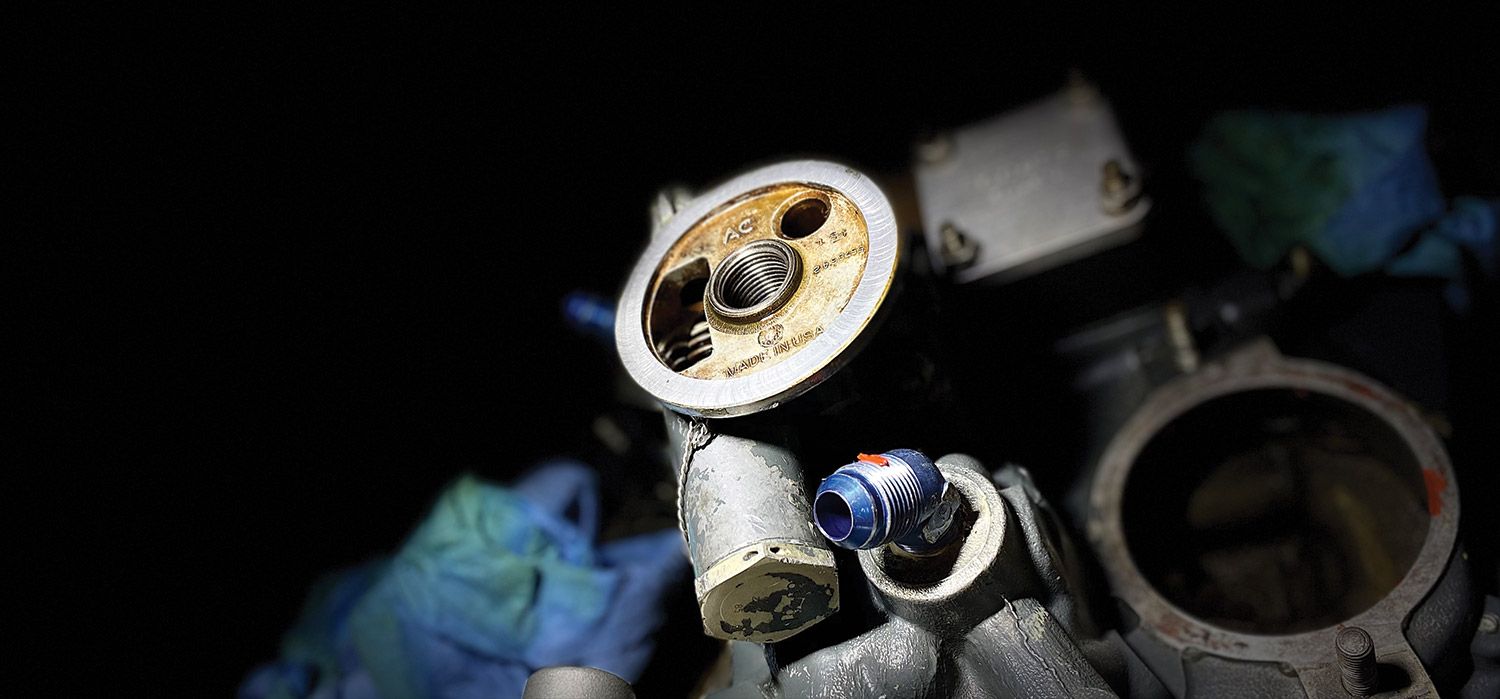 Oil is the lifeblood of the engine. Like blood in the human trunk, it circulates through diverse internal passages within the engine and externally in places similar hoses. In our engines, oil functions to lubricate opposing surfaces, helps prevent corrosion and helps absorb and then radiate some of the rut liberated past the combustion process.
Near of our aeroplane engines are prepare to keep the oil at a relatively stable temperature, usually from around 180 to 200° Fahrenheit. Much lower than that, and while it still performs its primary functions, it won't rid itself of the water byproduct of combustion, which can lead to internal corrosion. Much higher than that, and the oil and its additives might brainstorm to break down. Lycoming says the redline oil temperature for my IO-540-D is 240°.
An external oil cooler typically helps refuse heat. Because our airplanes fly through widely varying outside air temperatures, they naturally require a way of regulating the oil flow through the cooler, so the oil stays in the Goldilocks zone—not too hot, not besides cold. Some airplanes have manual controls that vary or restrict the flow of air across the oil cooler to achieve this (call back cowl flaps), but the majority of us flying Lycoming, Continental or Franklin engines rely on a temperature-sensitive device called a vernatherm or "thermostatic oil cooler bypass valve." The vernatherm is a
natural culprit to consider when dealing with oil temperature bug. Notation that oil temperature issues are ordinarily of the "besides loftier" variety.
Functioning
You're probably already familiar with the mechanism that makes the vernatherm work. The thermostat in your car'south cooling system does the same thing much the aforementioned fashion: It's a temperature-actuated spring-loaded valve in the coolant period. A spring extends to open the valve equally the coolant/antifreeze heats upward, thereby allowing a graduated menses of fluid to the radiator permitting the coolant to refuse the heat it has absorbed and so reenter the engine to start the process all again. The size of the valve's opening is proportional to the temperature of the coolant exiting the engine water jackets, to an upper limit corresponding to when the thermostat is at its maximum opening or flow. An early auto mechanic lesson near of learned underneath the shade tree was to replace the thermostat when the car was overheating. The vernatherm in our airplane engine regulates the menses of oil in our engines in a mode like to the motorcar thermostat only with critical differences.
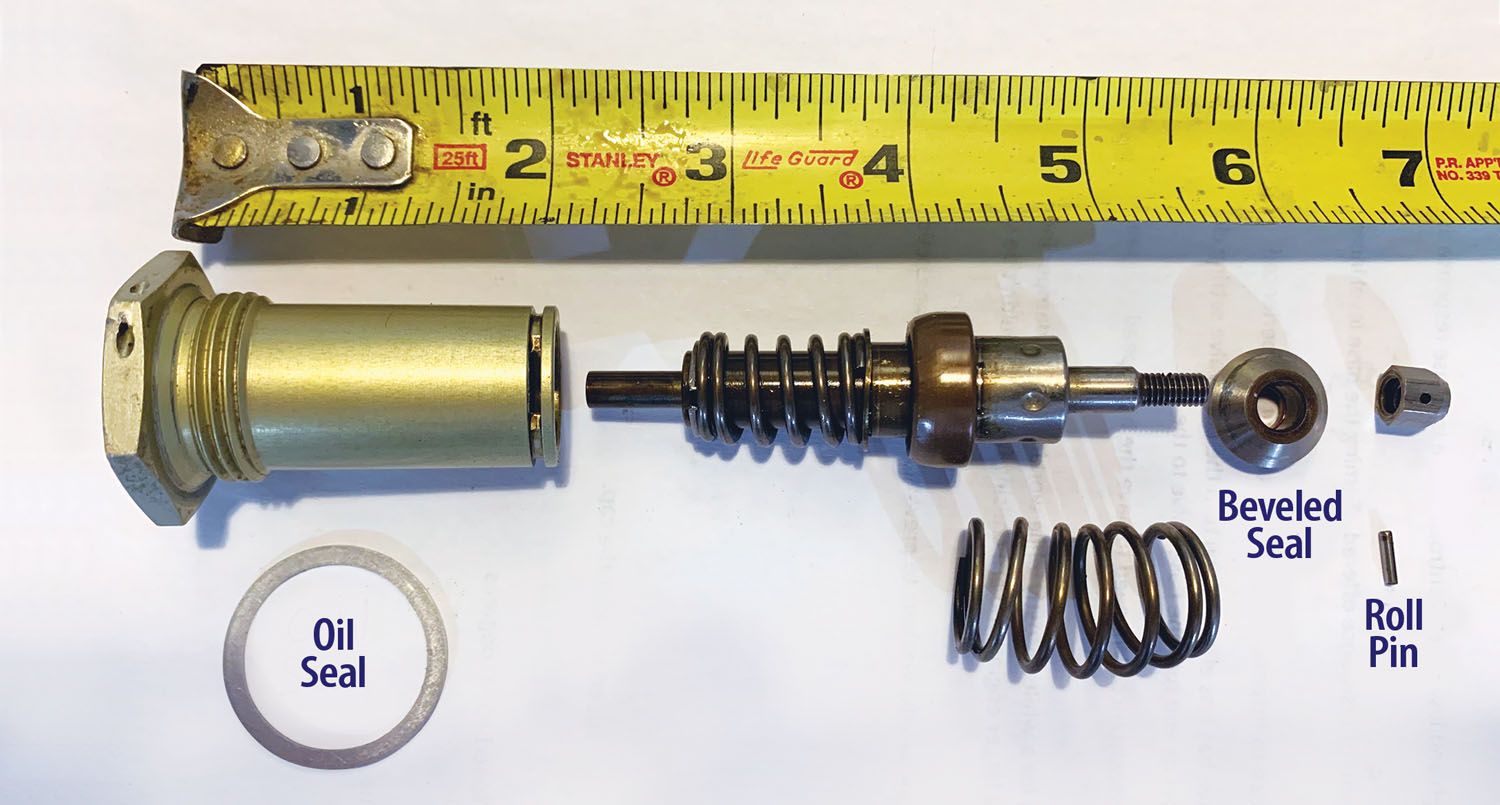
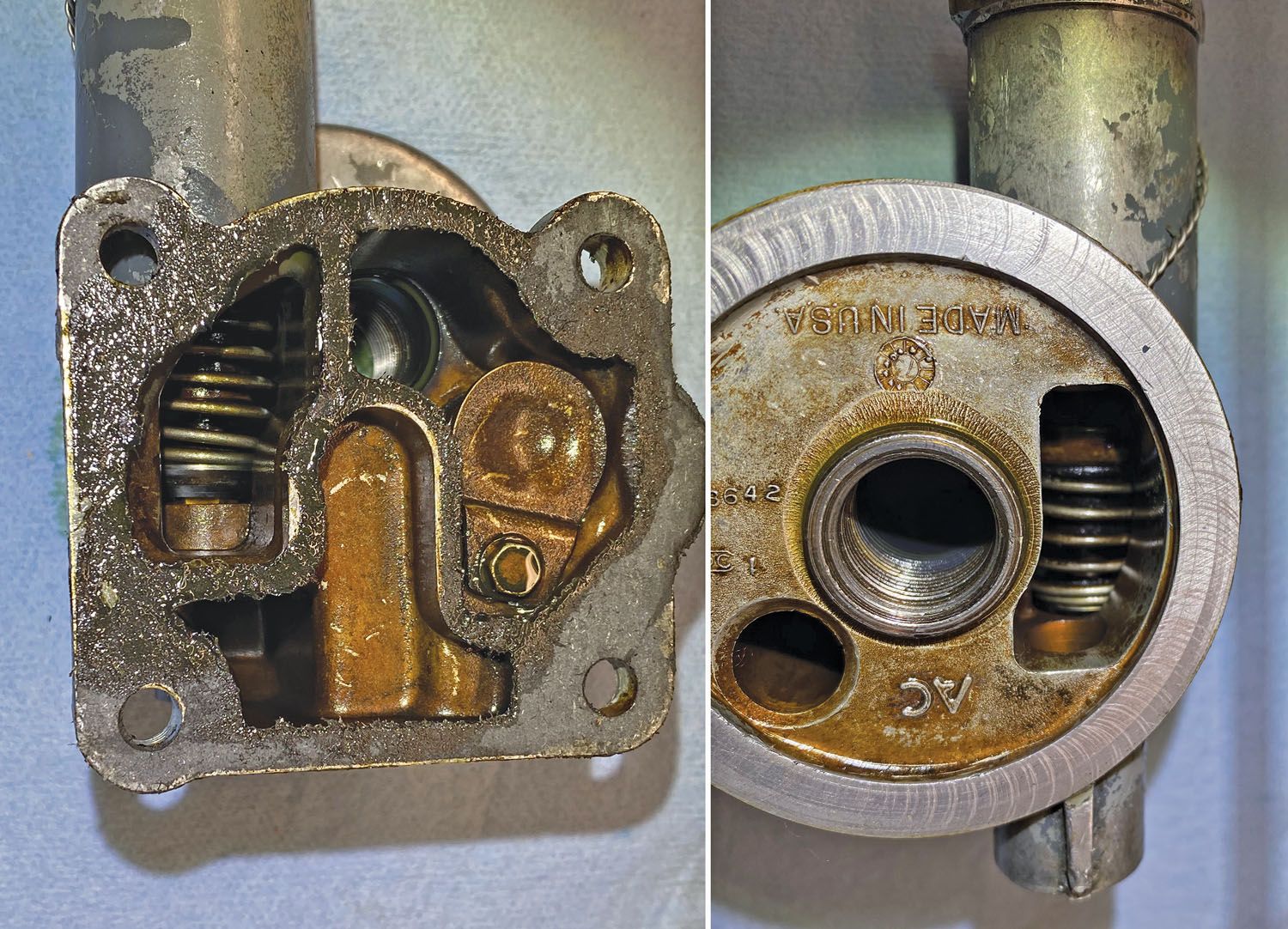
Where the thermostat in the machine allowed the passage of fluid past opening up a larger pathway for the coolant to the radiator, the vernatherm does sort of the opposite. In our engines, the cold or retracted position of the vernatherm allows oil to menstruation past the vernatherm and through an opening in the centre of a beveled seat, which leads back into the engine for apportionment. As the oil heats upwards around the vernatherm, the device gradually extends the askew end, pushing it against the seat, which closes off the menstruum of oil through the hole in the center of the seat. This has the effect of forcing the oil through the alternating oil passage in the accessory example and through the oil-cooler excursion. The action of the vernatherm is gradual with increasing temperature, thus automatically regulating the oil through the cooler. The vernatherm is calibrated to maintain a certain temperature range of the oil. The Goldilocks zone.
Dissimilar the automobile thermostat, which gradually opens upward more and more with increasing rut, the vernatherm seals off the cold oil passage as it heats upward. At a certain high temperature, the vernatherm is fully extended and completely sealing off the cold oil passage and forcing all the oil through the oil cooler circuit. Notation that the extension of the device with oestrus is not caused by the spring depicted in the photos. The spring only serves to hold the end tight confronting the seat when information technology is fully extended.
When troubleshooting high oil temperature, there are a number of things to check first before blaming the vernatherm. First, verify that the oil libation is hot to the bear on after a flight, confirming that oil is circulating through the cooler. If not, then go directly to the vernatherm. If oil is properly circulating through the oil cooler, make sure your oil sender is reading accurately. Consider simply replacing yours as the sender is non expensive. As well, you lot can examination the oil sender past rigging it up to a known temperature source like a pot of boiling water and then verifying that the gauge on the panel shows the expected temperature.
Y'all will also want to check the flow of air across the oil cooler. The science of aerodynamics, boundary layer airflow, duct shape and then on is exterior the scope of this article, merely suffice it to say that if air isn't flowing across the cooler, then it isn't going to cool the oil.
Removal and Inspection
The vernatherm is the next thing to cheque. Equally y'all know, every engine has at least ane part whose placement was determined to exact maximum frustration from the mechanic to the sadistic please of the engine designer. On my Lycoming IO-540-D, the vernatherm is that function. On some engines with remote mount oil filter adapters, the vernatherm is much easier to access. On Lycoming engines with an oil filter on the accompaniment case, the vernatherm is mounted vertically and threaded up into a fitting below the oil filter. On Lycoming engines with an oil screen and no oil filter, it is screwed in horizontally in the same surface area. On Continental engines, there is more variation depending on case design. Continental oil coolers are typically attached directly to the engine, and the vernatherm is mounted in the oil libation or directly in line with it. Lycoming Service Instruction #1255A gives guidance on updated parts and oil seals forth with installation instructions for Lycoming engines.
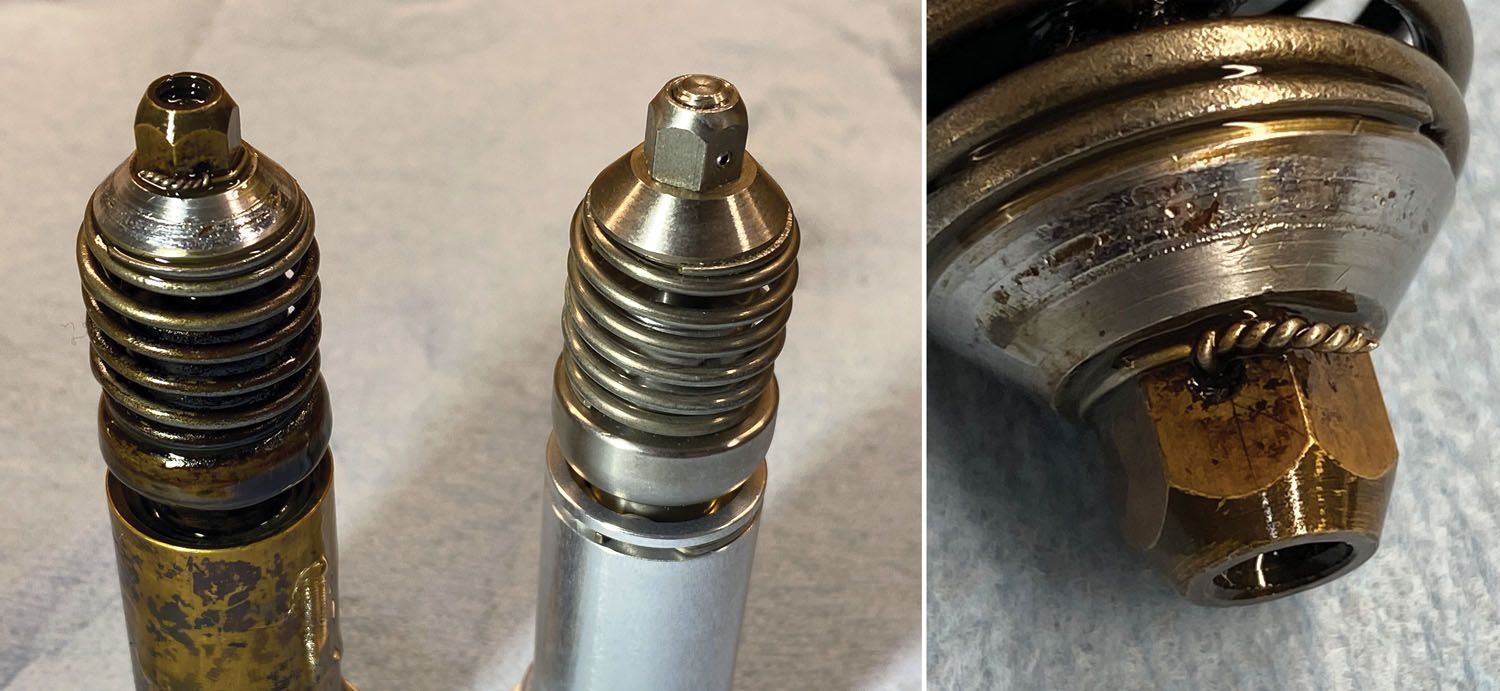
In one case removed, wait over the beveled head/plunger terminate. It should exist smooth and non scored or otherwise marred. Subsequently a curt period of use, at that place should be a faint outline of the seat concentrically around the beveled end. This faint mark indicates the vernatherm is making good contact/seal against the seat. Notation the threaded portion at the caput of the vernatherm. This screws into the fitting on the accessory case. Use a new oil seal here when reinstalling information technology. The beveled plunger cease is pushed against the seat up in the accompaniment case as the oil heats it up. Note that the beveled cease plumbing fixtures is threaded onto the rod at the center of the device, and the jump pushes directly up against its underside. The beveled end fitting is locked confronting unthreading via a roll pin visible in the photos accompanying this article. Y'all tin compress the bound by firmly pushing against the beveled end, but the spring cannot exist extended without unscrewing the askew plumbing fixtures from the threaded shaft.

Look over the device to meet if information technology is make clean and to ensure no contagion or sludge is impeding its operation. A concluding check of the vernatherm is to put information technology in hot water to verify its function. Practically speaking, if you immerse information technology in near-boiling water, it should extend to its fullest. The meticulous amongst us could effort a series of different calibrated temperatures of water from, say, 170° on up to boiling, but it's enough that it extends when it'due south at 180° or so. On my Lycoming, the difference in length from cold to hot is approximately half inch. I believe on Continental applications, the difference in length from cold to hot is less than a quarter inch.
Take a close look at the seat to verify it is smoothen and free of nicks, scuffs or droppings and for signs of featherbed or failure. In applications such as mine, this is easier done with a telescopic than the eyeball, non least because it might drip a little bit of oil.
Kludges and Random Fixes
My feel is that the vernatherm either works or it doesn't. I have heard anecdotes from other builders that using the same vernatherm reinstalled in a new remote mount oil filter bypass solved their oil temperature problem. This could be due to the vernatherm now sealing improve with a different seat in the remote kit adapter, or but the additional oil plumbing to the remote mount filter immune greater heat rejection. I have also heard that one builder replaced the vernatherm with a new one twice before solving his problem for no discernible reason. I am also aware of at least one person who solved their oil temperature trouble by disassembling the vernatherm and installing a washer or spacer nether the spring to increase the spring pressure level belongings the end into the seat. If you go this route, start with a very thin spacer, similar the size of a thin AN washer. Yous could besides theoretically unscrew the beveled end a half or full plow and reinstall a roll pin, slightly lengthening the device. I am also enlightened of i case where the curlicue pin dislodged, allowing the beveled end to begin to unscrew, but the failure forced an before seal onto the seat and about of the oil into the cooler, so no actual harm ensued except for the oil not getting hot plenty on cold days and the whorl pin hopefully dropping harmlessly into the sump(!). Bear in heed that the associates is cleverly designed so that in that location isn't enough clearance for the beveled terminate to completely dislodge and fall out of line with the seat or become loose and offset rattling around in your engine.
To be clear, I do not recommend the above surgical solutions to the vernatherm. In whatsoever case, it's probably non necessary to disassemble and try some kind of repair to the vernatherm. In most cases, if the vernatherm isn't working, simply replacing it solves the oil temperature problem.
Do Equally I Say, Non Every bit I Do
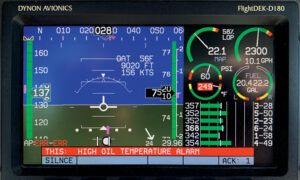
I emphasize that information technology is vital that you verify that the oil temperature sender and its gauge are accurate and working correctly and that the oil is flowing through the cooler before futzing with the vernatherm. On my Velocity, I accept an older Dynon EFIS that digitally displays the oil temperature. I have consistently loftier oil temperatures in flight. For vii years and 400 hours, I saw oil temperatures in prowl of 225 to 235°. And this airplane has two oil coolers. I did endeavour to verify the accuracy of the oil temperature sender by testing it in boiling water earlier diving deeper into troubleshooting. I swapped out the vernatherm for a new 1. Still too high. For years I tried increasingly creative (and time-consuming) ways to prepare the trouble, including several radical alterations to the airflow across the oil cooler and a few unlike oil libation locations with all the downtime and fiberglass havoc that involved. I also came perilously close to irritating my on-field A&P and friend with ceaseless questions and complaints. No joy.
On i flight, I had to employ pitot oestrus. Non for the first time, heed you, only it was a rare occurrence. I flipped the switch, and the digital display of oil temperature jumped xv° then dropped fifteen° when I turned off the pitot heat. Later testing showed that when I shut off the avionics switch, the oil temperature magically dropped 15° merely to jump upwardly 15° when I switched information technology back on. Obviously, I take some stray electrons to corral to solve my oil temp "problem." For now, I cull to wing the bejeezus out of my aeroplane on fair weather condition days, troubleshoot electrons on other days and ever ship my oil in for analysis at oil changes. My vernatherm works just fine, thanks very much. In brusk, the simplest solution is probably the correct one and remember always to fix the cheapest thing first.
Postscript
In the process of reviewing this commodity, the editor suggested looking at a somewhat well known effect with Dynon oil-temperature probes for Lycomings—that they can be mistake prone where there is potentially a great deal of difference betwixt the engine ground and the musical instrument ground. The modify in readings with and without pitot heat suggested an electrical/indication outcome that I thought could be wiring.
On his suggestion, I tried substituting the Dynon sensor (model 100409-001) with GRT FT-LC-01 sensor; both mount in the traditional probe well on Lycomings. Legacy Dynon engine monitors tin can read this probe with a simple setup change.
Miraculously, by changing the probe, my oil temps fell past 25° with no other changes. Other builders report similar experience, and note that the GRT two-wire probe seems to work more than smoothly, with less of the "needle jerk" often seen with the Dynon probe. And even later on Dynon "re-characterized" the probe in 2006 to help reduce high-indicated oil temps, at that place seems to be some electrical sensitivity present.
Of class, the question could be: Which is more accurate? Was the Dynon correct and I exercise take high temps, or is the GRT closer to right and I've been chasing ghosts all along? Well, this is why nosotros test. One thing I know: Information technology wasn't the vernatherm.

Source: https://www.kitplanes.com/a-verna-what/
Posted by: goodmanwhentom1964.blogspot.com
0 Response to "How To Repair Damaged Lycoming Vernatherm Seat"
Post a Comment